Our principles
Principle 4: Work together through a source-to-sea approach to support our terrestrial, freshwater, coastal and marine environments.
|
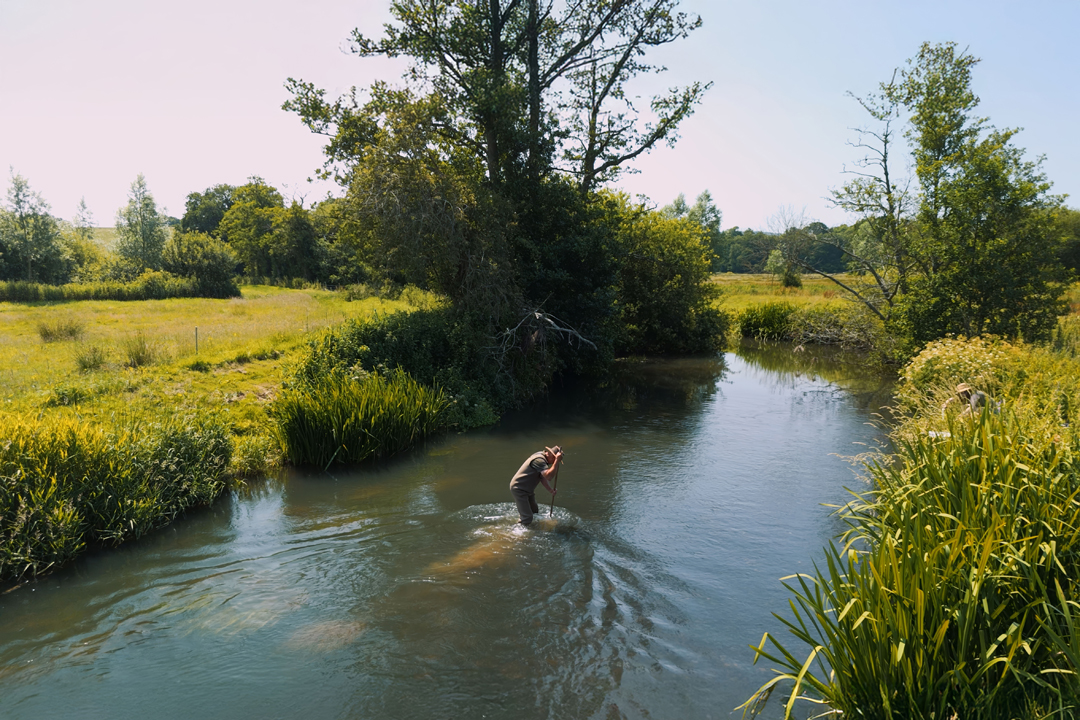
Conducting Riverfly Surveys on the River Stor, using river invertebrates to understand water quality and river health © Sam Moore, Western Sussex Rivers Trust |
Under the Environment Act, Local Nature Recovery Strategies (LNRS) cover terrestrial areas and the coast and their direct influence ends at mean low water spring. Therefore, they cannot set priorities for marine habitats and species. Consequently, the LNRS does not contain specific priorities or measures which relate directly to the marine environment or recovery of the habitats and species it supports.
However, in practice our land, freshwater, coastal and marine environments are all part of one connected system and what happens on land has an impact, not just on our freshwaters and coasts, but also on our seas. For example, globally around 80% of marine pollution originates on land – from agriculture, cities and industry – and is carried downstream into the sea, with far-reaching impacts for fisheries, tourism and communities. Certain land use practices upstream in catchments affect water flows and water quality in our freshwater systems, increasing flood risk experienced by communities, levels of sediment, nutrients and soil reaching rivers, estuaries and the sea.
A source-to-sea approach recognises that all these parts of the system are connected and that actions (positive and negative) in one part have knock-on effects across the rest.
In practice, the approach encourages everyone involved to work together, to think upstream and downstream, and to identify how to tackle pressures and improve the functioning of the whole source-to-sea system. It is, however, challenging to implement in practice given the fragmentation of environmental governance across organisations and spatial areas.
What is happening already
The source-to-sea approach is encouraged across the country by the Environment Agency. Catchment Partnerships are also in place for each of the catchments in the LNRS area and bring together the Environment Agency, farmers, landowners, local authorities, water companies, nature conservation organisations and others to encourage an integrated source-to-sea approach to action. Their work helps to identify actions and locations where a range of interventions, such as natural flood management, land and soil management, and habitat creation and enhancement can best be located to support the function of the catchment for the benefit of nature and people.
Recovery of the marine environment along the Sussex coastline is a local imperative and is being championed by pioneering initiatives such as the Sussex Kelp Recovery Project and Sussex Bay. Yet success, especially in safeguarding the health and functioning of our harbours, estuaries and seas, relies on actions inland and a sustained commitment to a source-to-sea approach.
The LNRS aims to help this by:
- Reflecting the importance of the marine environment to West Sussex, East Sussex and Brighton and Hove and its interdependence with our land, freshwater and coastal systems.
- Including actions to support recovery of coastal and intertidal habitats and species. (See Coastal Habitats and Rivers storymaps)
- Mapping and prioritising catchment actions that improve water quality and flow resilience (e.g. floodplain reconnection, river renaturalisation, natural flood management), benefitting wetlands, rivers, aquifers, estuaries and the sea.
- Supporting the work of key stakeholders such as Catchment Partnerships and the Environment Agency and through our understanding of the wider aims of existing relevant strategies such as Catchment Management Plans and River Basin Management Plans.