Our principles
Principle 2: Create a network of ‘bigger, better, more and joined-up’ wildlife-rich spaces across our rural and urban landscapes.
To support our core areas for nature, we also need to create new areas of habitat that expand the habitats around them and help them ‘join up’ across the landscape via stepping stones and corridors of habitats between them.
Being part of a healthy network will increase our core areas' resilience to pressures and their ability to provide ecosystem services such as pollination, flood risk reduction and improvement of water quality. It will also support our species by allowing them to move across the landscape.
Whilst the LNRS cannot identify new areas to be given legal protection, this principle - and priorities and measures arising from it - will help to support the UK’s commitment to protect and conserve a minimum 30% of land and sea for biodiversity by 2030, known as 30by30. The target is seen as a key driver in reversing the decline of nature in the UK, by expanding and improving our protected areas and creating new areas for wildlife, allowing nature to spill over into the wider landscape.
|
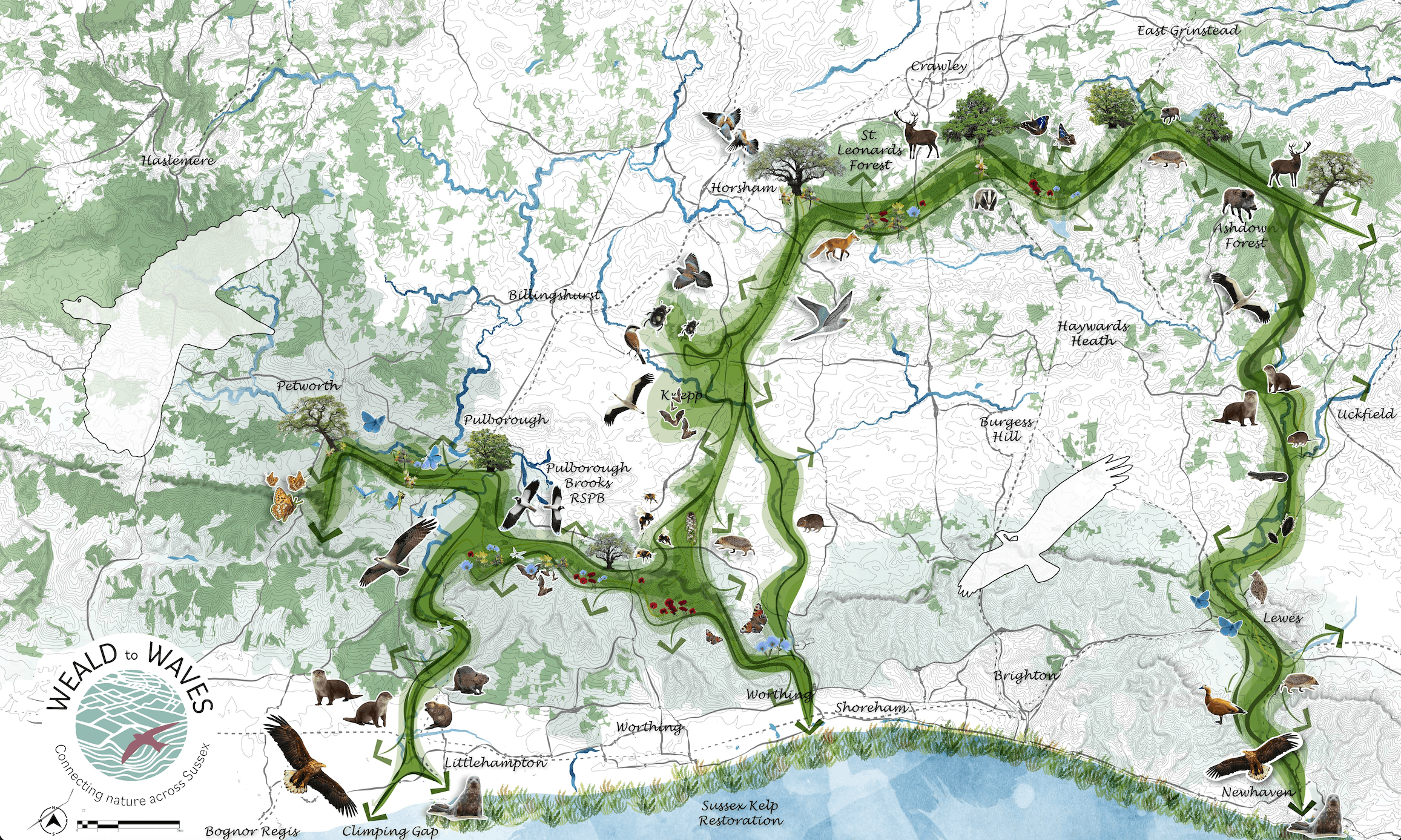
Founded by farmers and now a movement, Weald to Waves seeks to establish a 100-mile nature corridor across Sussex - the image above its its vision. © Weald to Waves |
What we have to do, where
The actions required to create a ‘nature network’ of high-quality habitats vary from place to place depending on what is there now. Some examples:
- Habitats in the High Weald are already relatively well connected, so in this area the emphasis should be on enhancing the condition of what is there already and expanding smaller areas of habitat where possible.
- Chalk grassland patches in and outside of the South Downs National Park are very fragmented, so expanding these areas and joining them up will make the most difference.
- Our farmed landscapes provide many patches and corridors of valuable habitat for wildlife, but the potential exists to expand and better connect these for nature alongside food production. At an even greater scale, there is the potential to create better habitat connectivity with designated sites and wildlife-rich areas beyond the LNRS boundary.
- Our coastal habitats across West Sussex, East Sussex and Brighton & Hove LNRS are at extreme risk from climate change. Due to ‘coastal squeeze’ habitats like saltmarsh, mudflats, vegetated shingle and sand dunes have very few places to go when sea levels rise. Key to their survival will be to identify where and how action can be taken to create new areas of coastal habitat where this may be viable and secure into the future.
- In many of our urban areas, a lack of parks, greenspaces or easy access to the wider countryside on their edges means that there are few opportunities for nature to thrive or for local people to connect to nature. Action by local authorities to create green and blue corridors in our built-up areas will help to connect people to nature while providing new and connected habitats for urban wildlife. Small actions at a local scale can also help to make our gardens, allotments, churchyards and greenspaces wilder and better able to support species.
The LNRS aims to help this by:
- Guiding the creation of a much bigger, stronger, more resilient and connected network of core areas for nature in across Sussex and beyond. (See the Nature Networks storymap).
- Targeting action where this will improve the ecological condition of habitats.
- Identifying strategic locations for the creation of new habitat, with an emphasis on locating this where it will expand or better connect the habitats we already have.
- Applying the ‘bigger, better, more and joined-up’ approach to urban areas, creating more opportunities for nature in spaces like golf courses, recreation grounds and playing fields.
- Providing information on the actions, big and small, which will help to support nature recovery across West Sussex, East Sussex and Brighton & Hove.